Monday, August 29, 2011

Echoes of old words

Half Heaven, Half Heartache:
Discovering the Transformative Potential in Women’s Popular Fiction
by Linda Ann Wheeler Hilton

An Honors Thesis Presented in Partial Fulfillment
of Honors College Graduation Requirements
Women’s Studies

Arizona State University West
May 2000


There is, or should be, little doubt that women love romance novels (Paizis 10-12; Thurston 3).  They also love romantic movies, romantic dinners, sentimental greeting cards, and flowers on their birthdays.  The difference is that movies, dinners, cards and flowers are commonly shared experiences, shared with and often even provided for by the woman's intimate partner, who also receives a benefit.  His benefit may be in the form of enjoyment of the movie or increased intimacy in the relationship.  (Crudely put, it means that buying her flowers and treating her to dinner and a movie entitles him, in his estimation, to sex.) fn 1

The reading of a romance novel, on the other hand, is a very private and personal effort (Brownstein 25), with little if any direct benefit to the man in the woman's life.  Though studies have shown women who read romance novels have a more active sex life (Grescoe back cover; Thurston 10), and this could be seen as a benefit to their intimate partners, the reading itself is rarely a shared activity.

Half Heaven, Half Heartache will look at romance fiction from the unique perspective of a radical feminist who has been "inside" both the romance reader's and the romance writer's worlds, as well as academia.  I hope to raise a new awareness of the complex issues involved.

______
1.  If the above definition seems resolutely heterosexist, I plead guilty, at least in terms of the definition of romance novel.  The mass market romance novel itself is resolutely heterosexist.  Although there are gay and lesbian romance novels, they have neither the quantitative audience nor the mainstream effect of heterosexual mass market romance novels.  Therefore, this study focuses only on the latter, with no cultural slight intended toward any other form.


Much has changed in Romancelandia since I wrote that thesis over 11 years ago.  Certainly the mainstreaming of gay and lesbian romances is one change, and then there is the whole e-publishing revolution which had just barely begun in the very late 1990s.  The various online communities of readers such as Dear Author and All About Romance and Good Reads have made reading much less of a solitary experience, as readers gather to discuss what they're reading, what they like, what they don't like.  Oftentimes the authors participate in the discussions, either to defend their work against critics or to join in celebration of good reviews and remunerative sales.

One thing that hasn't changed, however, is the short shrift romantic fiction gets from the critics.  As I posted here a few months ago, even academics who appear to have given the genre critical respect often just don't get it.

So after the encouragement I've received today over at Dear Author, I posted the opening sample above and now I'm going to settle back and review the possibilities.  As I wrote there, since I've gone back to actually writing romance novels after my long and not entirely voluntary hiatus, maybe I should revisit this thesis, too.

Tuesday, August 23, 2011

Giving meanings to the words

Once again, I want to state very clearly that there will be no reviews on this site, and what follows should not be taken as a review but rather as an observation and essay of opinion about reviews.  At least, that's the way it is intended.

The motivation behind this essay comes from two sources. 

The first is a report that an author has successfully sued a reviewer whose review was not just negative but contained factual inaccuracies that the court deemed malicious.  In the linked report, another reviewer defends reviewers and their snarky reviews.

The second is a scathing review and heated commentary on Dear Author regarding an author-published book.  I was one of the commenters, and my comments were a bit lengthy.  But there were some issues that I wanted to address beyond those comments specifically about the nature of reviews, and felt I could more appropriately explore those issues on my own blog.  So here I am.

It's already been discussed on several websites whether or not authors should also be reviewers.  There are pros and cons, and I've stated that I do review occasionally on Amazon those books that prompt me to make a comment.  I do not review under my own name.  Yes, sock puppetry here, one of the joys of the Internet.  Some of my reviews have been exceptionally harsh, as when a digital book is so badly formatted that it is completely unreadable.  And there was the instance where someone, perhaps the author's husband, took me to task for not liking what he considered a "masterpiece."

First sub-topic I want to address is specifically the issue of the validity of reviews on Amazon.

It appears to be quite well known and accepted/acceptable for authors of all stripes to have their friends and relatives post such reviews, even to the point of copying and pasting other people's reviews and slapping their own name on them.  Rather than examine that in detail, let's take it as a given then that most books will have a few biased reviews, and that those reviews will be almost universally glowing and full of unqualified praise.  Thus this is a masterpiece everyone should read right now.

How many such 5-star reviews is a book likely to get?  I'm going out on a limb here by guessing the appropriate number is six, or rather between five and seven.

Most people who write a book and get it listed on Amazon -- regardless how the book is physically published -- can come up with five to seven people who are willing to post glowing reviews.  They may not have written the reviews, and in fact they may not have read the book, but they are willing out of friendship with or family ties to the author to lend their names or sock puppets to the cause of promoting the book.  Fair enough.

Now let's take that one step further and apply it just to the small press, independent, and author-published books that may (or may not) have a small paper-and-ink print run (or are POD) but depend mainly if not exclusively on digital publishing such as Amazon's Kindle program or Smashwords.  This category includes such publishers as Ellora's Cave, Carina, Samhain, and others that are not mainstream, New York "legacy" publishers engaged in "Agency" pricing for their digital editions. 

These books do not get the promotion or the attention that legacy books do.  While Pocket or Kensington or Avon may be able to send out ARCs or print copies or even free digital editions to the major reviewers, the self-published author can't.  And the major review venues, whether Publisher's Weekly, Romantic Times, or Dear Author, are going to review those books their reviewers want to review and their readers (and/or advertisers) want reviewed.  In any given month there will be a lot of books released by popular authors, and they will get top billing, regardless of genre.  Dan Brown, Stephen King, Clive Cussler (or ghost), Patricia Cornwell, Jayne Ann Krentz -- these are the authors whose books will be reviewed the minute they hit the store shelves or the digital download servers, if not before.  And more often than not, these books get good reviews.

The author whose book doesn't get reviewed by the major sites has to rely on his or her own devices, and that very well may include getting someone to review the book and say that they liked it, loved it, even if they didn't.  As I stated a few weeks ago I was informed of an author-published book that I ended up not liking and gave a negative review, for which I got chewed out.  That book now has eight 5-star reviews and my 2-star review. 

Most of those seven other reviews contain nothing more than glowing praise for the book.  They give few details of the plot or storyline but call the book a masterpiece that grabs them from the first sentence.  Most of the reviewers have no other reviews at all on Amazon.  One is another self-published author.  One reviewer has about 20 reviews all posted within 10 days prior to or on the same date as the review of the book in question.  I haven't checked to see if they are cut-and-pasted from someone else's reviews, but they are posted in batches at a time.  Are those legitimate reviews?  I don't know, but I must admit I'm suspicious, which means I'm not inclined to believe them.

The problem is, Amazon uses those reviewer ratings as a means of sorting the titles.  The more and the higher the review rating, the higher the book will land on Amazon for the purchaser who sorts by rating.  This is not the default sort, but it is one way, and it must be used often enough if Amazon maintains it.

Now, I'm not even sure it's possible for me, under the guise of my sock puppet, to review my own book, and somehow that seems even too underhanded for me.  (Only kidding!  But you know what the book is so you can easily check to see what kind of reviews it's received at this point.  As of 8/16/2011, none.)  But it does make me understand why authors resort to it.

How are readers, then, to determine which Amazon reviews are valid and which aren't?  I'm only addressing Amazon at this point because that's the only system I'm familiar enough with as an author publishing there, as a reviewer reviewing there, and as a reader buying there.  Here's my formula for determining which, if any, Amazon reviews are valid: 

1.  Until the book (or story or novella) has at least 10 ratings, ignore them all.
2.  Ignore six of the 5-star ratings.  Assume they're from friends or family members who are biased.
3.  Of the remainder (if there are any) trust with reservations only those reviews from reviewers who have at least 20 posted reviews over the past six months in that category, i.e. contemporary romance, urban fantasy, traditional western, political thriller.

It's not a foolproof system, and it makes no guarantees, but it may help you weed out the stuff that gets big ratings but turns out to be icky.

And remember, I'm only talking about the reviews posted on Amazon and only for small press or author-published books, because most print-published authors will have other avenues for publicity and attracting reviewers.  This is, of course, especially true in my particular genre, which is romance, where there is a huge online presence of writers, reviewers, readers, etc.

If you discount the first five to seven glowing reviews and look at the rest with an informed eye, I think you can much more fairly determine which are the valid reviews.

The reason I begin this long rant with that introduction is that, as has been discussed many times in the blogosphere, self-publishing opportunities at Amazon, Smashwords, and other outlets allows writers to bypass all the traditional gatekeeping that the print publishing industry used to perform.  This includes the functions of agents and editors not only to select the publishable manuscripts but to take those that are potentially publishable and make them publishable through directed editing and revision.  It is now possible for anyone to compose a story of any length, design a 600 by 800 pixel cover for it, upload it to Amazon or Smashwords, and sell it right alongside the 600 by 800 pixel cover for the latest from Nora Roberts, Erik Larson, Laura Hillenbrand.

The question then becomes how does the reader slog through the sea of dreck, and how does the author find an audience?  Is it fair that some authors will in fact not find an audience?  It may not be fair, but it is probably true.

How the readers find the material they want to read is a different but related matter, and it may be as unsatisfying as sitting down and sifting through the gazillions of titles, looking at product descriptions (the equivalent of back cover blurbs), reading reviews, and reading free samples.  The trade off, of course, is that readers now have more choices, but at a price in time and effort if not cash.

Every reader, of course, takes a risk when buying a book.  (Not when borrowing from a friend or library or the free book exchange at the local coffee shop.)  No matter what the recommendations from reviewers, no matter how intriguing the samples, there's always the chance of getting a dud.  That's pretty much what happened over at Dear Author last week-end, when reviewer DA_January read a book she ended up not liking.

I'm not going to post the book's title or the author's name here, because I don't want this blog to become a link used to promote the book.  I was so appalled at what the review said the book was like that I downloaded the free sample from Amazon.  When I had finished the free sample, I had to say that my views on the book pretty much coincided with January's, and I was not shy in voicing my opinion.  I rarely am.

For anyone who doesn't wish to go over to the other site, read the review, and read the 250+ comments, I'll summarize --

The book is set in Britain during an indeterminate historical period alleged to be a generation or so prior to the rise of King Arthur.  Various petty kings and dukes are fighting it out for supremacy, presumably because the arm of the Roman Empire has been withdrawn.  One of these kings defeats a duke and takes the duke's castle, possessions, and daughter. Most of the duke's people are slaughtered, many of the women raped, including the duke's daughter, who is to be the heroine of the story.  The hero is the victorious king who orders, participates in, and/or condones all the raping and slaughter.

DA_January, the reviewer, took exception primarily to two elements of the writing.  One was historical accuracy, the other was characterization.

Let me deal with the latter first.  The king who orders and/or condones the slaughter and rapine is the hero, and the reviewer felt that under the subjective standards of the romance genre, this type of behavior was not consistent with "hero" material.  She cited numerous examples of his, dare I say it, savage and unrepentent ruthlessness, and from that determined she could  not accept him as a viable hero because the author never redeemed him. 

The duke's daughter heroine, on the other hand, was described as being too passively accepting of all the trials and tribulations and trauma heaped on her, especially the frequent brutal rapes, without much resistance or reaction.  Her primary means of coping with her situation seems to be rationalizing that everyone gets treated this way and it's no big deal.

Eventually, the author of the book showed up on Dear Author and made a statement, as did a couple of her supporters, all of whom based their support on the concept that rape was a reality in historical times and therefore it was valid as an element of this novel.

Over and over and over, through the better part of 250 replies, the book's critics continued to state that yes, they understood that rape was a historical -- and contemporary -- reality and that was not their issue.  Their issue was with the way the author had written the character's response to being raped, the contention being that a writer can include anything she wants in her book so long as the reader finds it acceptable.  And too many of the readers on Dear Author were saying the author hadn't made these elements acceptable.

The quote I think applies here is "You're entitled to your own opinion; you are not entitled to your own facts."

Responding to a more or less rhetorical question of "Don't the book's supporters get it?" from one of the posters on the Dear Author, I wrote the following:

IMHO, they're missing the point.
The serious discussion here on DA -- setting aside early speculations about whether the author was a real person or the cover quote was legit -- has focused on the quality of the writing in terms of how it integrated the dull facts into a believable and enjoyable story. Enjoyable does not have to be rainbows and puppies and kittens. Enjoyable in this sense means satisfying.
My mind has gone blank right now and I can't remember which famous author has been quoted as saying that the difference between truth and fiction is that fiction has to be believable. What I read of the free sample of this book did not present what I know of reality in a believable way. And for the most part, I think the commenters here have stated the same thing.
No one has denied that females can get pregnant at the age of 11. What we have stated is that the "facts" as presented in the book are contradictory in a way that is consistent with sloppy writing. In other words, Ector is described as liking his sexual partners "before their womanhood," which implies a prepubescent female, once who has not developed a woman's body and has not started menstruating. So either Ruth is, at 11 or 12, sexually mature and capable of conceiving, in which case she would not be attractive to Ector, or she's not sexually mature and therefore not capable of conceiving. The fact that author leaves this contraction intact -- there are a lot of ways to resolve it -- shows to me and apparently to other readers that the writing is sloppy, it needs revision or editing, it's not ready for publication.
That's just one issue, and if it were the only issue, the book might have succeeded with DA_January. The problem is that there are so many similar issues.
There's another major problem and that has to do with the claim of historical accuracy. Again, this is something that many commenters have referenced. In order for an author to claim her work is historically accurate, she has to pick a specific historical time frame so that that accuracy can be verified. The research details she's included -- the arms and weapons, the costuming, the names, the artifacts -- are not indicative of a single well-defined era. did the items exist in history? Yes, but not at the same time and not at the time she's claiming if any, but vaguely in the Arthurian age, since that's what's stated on the cover of the book. If we write about the American Civil War, we don't include the battle of Bunker Hill or President John Paul Jones or jet fighter planes; if we do, we don't claim historical accuracy.
Once again, it seems the supporters of the book and the author are claiming that the critics and detractors are just upset because there's brutal rape and violence in the story and saying that those elements are historically incorrect and/or have no place in fiction or even in romance fiction.
1. We've all pretty much accepted that rape and violence and all that other nasty stuff are valid history.
2. We've all pretty much accepted that rape and violence and all that other nasty stuff can absolutely have a valid place in fiction and in romance fiction.
3. We've all pretty much accepted that the author of this particular work just didn't do a very good job of incorporating these elements into a viable, readable, enjoyable, satisfying, cohesive novel.
None of that is a criticism of the author herself.
What I think some of us have criticized, however, is the attitude of the supporters and perhaps even of the author herself in making claims about our criticisms and the motives behind those criticisms.
For years and years and years and sometimes even to this day, I've had nightmares about a scene in a book I read at the age of maybe 15 or 16. It was profoundly disturbing, and even to recall it now will probably distress me for a day or two.  The scene involved a woman describing watching her children being murdered by a mob. The author addressed her horror in a way that conveyed the absolute numbness that was required for the character to get beyond such a trauma and continue to function while at the same time showing the monumental effort it took to maintain that numbness. 
That kind of description was lacking in the reviewed novel at Dear Author.  And that was what was being criticized.  The book's supporters, however, seemed unable to grasp what it was we critics were criticizing, and instead they insisted we were denying -- or rewriting -- historical reality.

It's almost impossible to argue with people like that.  It's not just that they're stubborn -- a comment of mine which prompted some slight amusement -- but that they have invested themselves in what they see as a personal attack on the author when it is no such thing.

Why is this important?  And what's the connection to the first cited news item about the critic who got sued?  It's important because, as a later thread discusses on Dear Author here, reviews are part of what reaeders go by when choosing what to buy AND because in this age of digital publications, there's almost no way to return your purchase if you find out it's a dud.  Wary readers who have been stung too many times by gushing reviews by friends and neighbors that lead to sucky books are now unwilling to part with even small sums to try the untested works of new, digital-only authors.

The first article, of course, shows that even professional reviewers can and sometimes do lie to further a personal agenda.  One of them got caught because what he did was detrimental to the writer's ability to earn a living.  No one is going to sue the reviewers who lie to promote the work, and yet they do it all the time.  So the issue is not whether the reviews are honest but rather are they beneficial.  If they're beneficial to the author's bottom line, lying is apparently all right. 

Reviews should be fair and honest.  Should be, but often aren't.  And this hurts the good writers far more than it helps the bad ones.  Ultimately, if a book -- or novella or short story -- is good, it will stand on its own.

Or at least that's the way it should be.

In the week or so since the whole brouhaha developed over at Dear Author, I happened to post another review -- under my "alias" -- for another book that I had read only the free sample of.  I saw the book, cover, and basic description on a generic surf through Kindle titles.  Again, the title and author aren't important and I'm not going to give free linkage to them.  The writing was appallingly bad, with virtually every grammatical error known to the English language commited within the first 10 pages.  Egregious flubs such as "...he had went to find..." and "...she put there bags in the carraige[sic]..." and "Galloping across the moors, her cloak soon became soaked with the rain" and you get the picture.  There were e-book formatting issues as well that made the book difficult to read in the Amazon Kindle version -- inconsistent paragraphing, new chapters starting in the middle of a line of text, etc.  

Despite this, the book had four or five 5-star reviews and no others.  Three of the reviewers had reviewed nothing else.  The reviews were generic along the lines of "This is so wonderful, everyone should read it!" with no real analysis or description of the book.  Under normal circumstances and based on my "formula" for validating reviews, I'd have dismissed all of these.  And so I posted my own review, with a brief analysis of the writing style problems as well as some comments on the novel's structure -- like the two-page, single paragraph info dump as the heroine's sister "reminds" the heroine of the heroine's life story prior to the opening of the book.

Yesterday I received via email from Amazon a notification that someone had commented on my review.  The brief comment basically stated that "this reviewer has X number of reviews on Amazon and 75% are 1- or 2-star reviews.  Guess you can't please some people."  I immediately went to the book's listing on Amazon to post a reply to that comment, but the comment had already been removed.  I have no idea why.

My response, of course, would have been to point out that there are far more reviewers who seem to be very easy to please, who toss around 5-star reviews as if they were Mardi Gras lagniappes.  It's only the negative reviews that come under fire.

As a result of that disappearing comment, however, I decided to check and see if there were comments attached to any of my other reviews.  I already knew about some of them, and I found only one other that I hadn't seen before, and this one pretty much said the reader was glad to have more details about the book than just gushing praise.  So I felt pretty validated by that.

I also knew that one of the books I had severely trashed -- primarily for the formatting that made it literally unreadable -- had subsequently been removed from Amazon, but what surprised me yesterday was to discover that two other NASP books I'd given critical reviews to had been removed as well.  I have no idea why they were removed, and I can only assume they were removed by the authors unless there was material in them that violated Amazon standards in some way.

Maybe that's a point that has to made, too.  If we take it for granted that most NASP books are going to  receive at least a few 5-star fab rave reviews, then maybe someone somewhere needs to step up and be the gatekeeper who warns the unsuspecting.  Amazon and the other digital publishers will not step up and do this; they are making money off these books; not only do they not have to be gatekeepers, but they don't want to be gatekeepers because, unlike print publishers who have/had a substantial financial investment to recoup, it's not in their best interest.

More on this later.  It's gone on long enough, and probably most people have lost interest by now anyway.


*NASP = New Author, Self-Published

Sunday, August 21, 2011

Shirley Jean Stryker Mueller 1928-2011

Shirley was the only child of Cornelius "Neil" and Gertrude "Petie" Stryker and became my aunt when she married my mother's brother, Richard Mueller.  They were my Uncle Dickie and Auntie Shirley.  Yesterday morning she passed away, apparently of a stroke, in her sleep.

My thoughts of course are with my cousin Connie Mueller Fiorelli, her husband Paul and their two daughters Dina and Julia.  Like her mother, Connie was an only child but she has an extended family to rely on, too.

We were a small extended family.  I knew no relatives on my grandfather's Mueller side, but my grandmother Helene Andrews Mueller had two brothers, Harry "Hap" and Leonard, and I knew their wives and children, who were my mother's cousins.  My mother's two brothers, Ted and Dick, also married into very small families.  Shirley, as I said, was an only child; Ted's wife Barbara had just one half-brother who was only a few months older than I.  Therefore I knew the in-laws -- Neil and Petie Stryker, and Ken and Jessie Kenshol -- as well as I knew my own grandparents.

Neil Stryker passed away before his only granddaughter and namesake, my cousin Connie, was born, but I remember him, and of course Connie's grandma whom we all called Aunt Petie. 

And it's because of that small extended family that I have such wonderful memories of my Aunt Shirley.

Shirley grew up in a house on the corner of Lunt and Olcott in Edison Park, Illinois.  Her parents lived there until Neil died, and we had many many family holiday dinners there.  The house still exists and was recently for sale.  The online listing included a number of interior photos, and while I was a bit shocked at how small the house was compared to my memories -- I last saw it when I was seven, so my perspective was appropriately scaled down -- much of it was still instantly recognizable even 55 years later.

Some things are different though, which is to be expected.  Gone is the breakfast nook in the kitchen that looked out over the backyard, a breakfast nook painted in bright red enamel.

I loved that house.  Even though I was only a child, it fascinated me for so many reasons.  Years and years later, long after Uncle Neil had died and Aunt Petie moved into the duplex in Niles with Uncle Dick and Aunt Shirley and Connie, long after Connie had married and Aunt Petie passed away, I started to write a novel, a kind of modern gothic about a house haunted by spirits seeking the truth about an old injustice.  The more I wrote, and the more details I added about the fictional house, the more it was beginning to resemble that house in Edison Park.  But this was the early 1990s and there was no Internet and Bing and Google, and so one Saturday morning I picked up the phone and I called my Aunt Shirley to ask her about the house.

There were things I remembered so clearly, but there were other things I didn't.  She filled in details, and she was also surprised at how much I did remember.  Both of us had a good laugh when I told her how terrified I was of the grinning mouth -- it's difficult to describe -- that sat on the kitchen counter to hold the dish scrubber.  And I had been absolutely enthralled by the fairy princessy blue upstairs bathroom which I, as the only one of the cousins who had reached the magical age of seven, was allowed to use. 

She talked about the crystal door knobs, the walk-in closets, the perfume shelf in that blue bathroom.  I talked about the landing on the staircase where the doll case stood.

We had a marvelous and fun conversation, and at the end, Aunt Shirley promised to sketch out the floor plan for me so I'd have it as a guide when I wrote the rest of the novel.

But there was one other detail, a silly and totally inconsequential detail about that house that my aunt grew up in that remained with me.

There were window shades in that breakfast nook, I suppose because the window faced east and the morning sun could be strong even in Edison Park.  The wooden booths were painted bright red, perhaps to match some of the tulips that grew in the backyard the window looked out on.  And also to match that red was the pull on the window shades, a little nothingness of a piece of red plastic in the shape of a pair of wooden shoes with red tulips growing out of them.  (The Strykers were Dutch.)

Why would a child of no more than seven years notice such a tiny thing, let alone remember it?  But I did.

Aunt Shirley laughed with me at the memory.

A few days later, an envelope arrived in the mail, a slightly bulging envelope.  In it were three pieces of ordinary paper from an advertising tablet, with the floor plans of the first and second floor and basement neatly drawn on each.  What caused the bulge in the envelope was whatever was contained in the smaller envelope inside, on the outside of which was written "A memory?"

Inside was the plastic shade pull, its cord neatly wrapped around the plastic wooden shoes and tulips.

How could she ever have known?  How did she get it?  When did she get it?  I don't know.  I don't know.  I just know that she sent it to me and it was the one single thing from that house that I remembered more clearly than anything.  Nothing at all could have meant more to me.

It wasn't my house, and she was only my aunt by marriage.  But something, something magical, made that connection from that very special lady.

Connie, Uncle Dick, Dina and Julia, I know that you are missing her more than anyone else possibly can, and my thoughts and love go to you all.  May you find consolation at this sad time in knowing that there are others she touched in special ways, too, in ways that continue to reach out and bring smiles with the memories.


Wednesday, August 10, 2011

As the words begin to flow again -- and 16,258

That's my objective for today -- to have 16,258 words accumulated on The Stolen Queen.  I may or may not make it, but I will at least try.

After taking my daughter and grandson -- the next Wayne Gretzky -- to the airport Monday morning, I returned home and began putting my house and studio back in order, then turned my attention to the writing.  I'd been away from The Stolen Queen so long that I had to read through what I'd already written to immerse myself in the story once again.  That distance, however, allowed me to fix a few small weak places I hadn't seen the first time through and when I actually began writing again yesterday, I had a better sense of where I was.

I didn't meet my 1,000-word goal yesterday, adding just a little over 300 words.  But it's something.

Part of returning to the writing was also returning to my reading, especially of the various blogs and websites from which I've been pulling information about writing, publishing, marketing, and so on.

As I said before, this blog isn't going to contain reviews, though I may comment from time to time on books I've read.  But in reading reviews of other books -- specifically of romance novels -- I noticed what appeared to be a disappointing pattern.  Yesterday brought some confirmation of my suspicions.

The first was a thread at All About Romance regarding setting as a trope in historical romance.  Many of the readers who posted responses not only stated that they prefer books with specific settings but also either stated or strongly hinted that they prefer these settings because they are familiar, comfortable, non-challenging, non-political.

Which settings are these?  At the top of the list is Regency England, that short slice of British history at the end of George III's reign when his son, the Prince of Wales, was the effective ruler.  As the opening post on that AAR thread states, romances set in the Regency period, whether they are "traditional" Regencies in the style of Georgette Heyer and Jane Austen or more involved Regency historicals of the sort written by Kasey Michaels or Julia Quinn, feature upper class characters in upper class situations that rarely touch upon the messier historical aspects of the period, such as child labor, poverty, colonialism, and so on.  Several of the posters on the AAR thread specifically stated they didn't want to read about that sort of thing.  Some wrote that it was out of laziness; others just said they didn't want to think about racism or poverty.  Only one poster had anything negative to say about the Regency trope.

The second was the Tuesday links post at Dear Author referencing PubIt review pitches.  (I'd explain that, but you might as well click on the link and read it there.)  What disappointed me was that Dear Author stated they only review books from 50,000 to 80,000 words.  Even my "short" novels for Zebra Heartfire -- including Secrets to Surrender -- were well over 100,000. 

My conclusion, from reading these two threads at two different websites, is that there is little market for long historical romance novels set outside the English nobility in the early 19th century.  The American West?  Nah.  Medieval France?  Nope.  Tsarist Russia?  Not on your life.

Ironically, of course, most of the criticism of romance fiction comes from the socially conservative right, even though most of romance fiction supports the exact same values as the social conservatives -- one man, one woman in traditional marriage; and unearned wealth/entitlement as a mark of God's grace.  And nowhere are those values more prominently displayed than in the Regency-themed historicals.

Many of the readers who post at AAR frequently admit to being conservatives, so their statements are not surprising.  The readers and reviewers at Dear Author are less conservative on social issues, at least as far as gender and sexuality.  Many of the books reviewed there are male/male, female/female or other gendered romances and erotica.  The reviewers also read many contemporary category romances, with a current emphasis on the newly e-pubbed versions of Harlequin, Silhouette, and Loveswept backlist titles.  But until I read the thread about the PubIt reviews, I did not know Dear Author had a word count limit.

In a way, this explains the current trend toward multiple book series which feature siblings or friends or members of an extended family.  The author can write shorter books, all using the same research, but carry an expanded plot arc through as many as half a million words, a million words, or even more!  (The same applies to paranormal/vampire/shapechanger/whatever novels which require world-building that may be the equivalent of historical research.)

I am not opposed to change.  If I were, I would never have embraced the technology that allows me to publish my own books at almost no expense.  But I do find some changes unsettling and uncomfortable.  My preference is for a long narrative that combines adventure and romance all wrapped up at the end with a securely happy ever after ending.  That's the kind of book I like to read, and the kind I like to write.  Well I have to change my format as I go forward with the new books I'm writing?  Will The Stolen Queen be forced to evolve into a series?  Will its ending become the beginning of a sequel?

I don't know.  What I do know is that I can't address those issues until this book is itself complete.  I haven't reached today's quota of words.  I'd better get back to it.


Wednesday, August 3, 2011

Getting the words out there, and then getting the word out.

A zillion obligations have interfered with my writing life lately, most important being preparation for a week-long visit from my daughter and grandson.   By "preparation" I mean, ahem, cleaning my studio sufficiently that they had a place to stay.  And of course I had to do that while still working the day job, minding the usual household duties, and trying to write, too.  You can guess which got the last attention.

However, I did manage in between all the other high-priority tasks to format Secrets to Surrender for Smashwords, and it is now available there as well as Amazon.  Somehow or other Smashwords makes their "catalogue" available for Nook and Kobo and all those other formats as well.  I don't  know exactly how they do it, but they do.

Self-promotion is not my forte.  If anything, it's my greatest weakness.  I joined Facebook and I added a self-promoting signature to my email, but I'm not sure exactly what to do next.

The self-e-publishing part is actually pretty easy, but the self-promotion part is something I'm definitely going to have to do more research into.  Could I pay someone to do a lot of it for me?  Probably.  But that puts everything back into the hands of the middlemen, and my objective is to keep them as far away as possible.

Tuesday, July 19, 2011

They hate us for our beauty

There's been a little bit of discussion over at All Day All Night Romance Divas regarding why critics -- usually social conservatives -- heap so much scorn on women's romance fiction, and I made the comment that it's almost always and only "traditional" romance fiction that gets accused of turning women into sex addicts (or whatever).  Exempt from the criticism are gay (m/m) romances and lesbian (f/f) romances.  One of the divas wondered why that is.

I can't speak from anything other than my own personal logic and experience, but here's my theory.

The social conservatives are as anti-gay as they possibly can be, and they logically ought to be out there claiming gay and lesbian romance fiction is a serious threat to . . . . civilization.  But though they won't admit it publicly, I believe they're more concerned about the real threat of traditional -- meaning one man, one woman, Happily Ever After -- romance.

Traditional romances celebrate and inculcate the conservative norm of one man, one woman, HEA.  That's a good thing, in the eyes of the social conservatives.  And if that's all romance novels did, the social conservatives wouldn't have a problem with them. They'd be quite happy if women read Grace Livingston Hill, Catherine Cookson, and Emilie Loring from now until Armageddon.

Is this a contradiction?  Yes, and no.  As I wrote at ADAN Divas:

Most writers and most readers, in my personal opinion, fail to recognize that just because the heroine gets to have great sex does NOT make the story pro-woman. There are contradictions that are rarely explored.

What happened in 1972 with the publication of Kathleen E. Woodiwiss's The Flame and the Flower is that female sexual satisfaction as an expectation was thrown onto the table.  It's not just that the heroine has great sex; it's that her pleasure becomes obligatory and the hero has a responsibility to oblige her.  His sexual satisfaction -- and her duty to provide for it -- was always taken for granted; her sexual satisfaction was often denied, ridiculed, condemned.  But because Woodiwiss published at a time when artificial birth control relieved women of one of the major physical, social, and economic consequences of sex, her heroine's sexuality became part and parcel of her being.  Woman's sexuality was turned from The Original Sin into A Damned Fine and Beautiful Thing.  The thing that made Eve the fall guy for all of human ills -- her being a sexual being -- got turned around 180 degrees.

Many of the novels that have challenged the patriarchal status quo -- white men on top, women and all others below -- have dealt with female sexuality.   Lady Chatterley's Lover.  Forever Amber.   Peyton Place.  Fear of Flying.  They addressed the right of woman to own her own sexual pleasure.  And if a woman takes back her pleasure, she takes back the power of a man to own her.

Gay and lesbian romances don't challenge that power structure.  There is no male-as-owner-of-the-female power structure in the individual relationships.  And as long as the social conservatives don't see gay or lesbian romances as interfering with the power structure, they aren't going to bother beyond the general and all-encompassing condemnation of anything that even hints as GLBTQ people as real.

Because if they were to attack the m/m or f/f romance novels, they would have to do so from a position of accepting that gays and lesbians can even experience "romance."  That they are people who can love and commit and care, and that, too, is outside the sphere of experience for many social conservatives.  (It should also be noted that many men who publicly claim to be social conservatives are also heavy consumers of print pornography which contains more than its share of f/f sex.  While socially conservative men might want to censor written f/f stories, they aren't going to cut off their own enjoyment of illustrated f/f sex.)

It's difficult to denounce something without first admitting that it exists. 

Much of the criticism of women's reading of romance novels manifests in an accusation that too much reading of romance "ruins" women for real life relationships.  The readers are encouraged to put the books aside and concentrate on their husbands and their marriages.  The readers are told they will develop unrealistic expectations that can never be fulfilled and will be resultingly miserable the rest of their lives.

There is never any suggestion that what the heroines of Romancelandia are given by their heroes -- full measure of pleasure in their sexuality even when being raped -- ought to be and could be and should be the expectation of any woman who is the heroine of her own life.

Monday, July 18, 2011

The dilemma of cover art

I've posted here  a couple of times about the bad cover art that shows up on some books, and the whole issue of cover art on romance novels is nothing new.  We went through the nursing mother covers -- heroines portrayed as young women so well endowed that they must have been lactating -- and of course Fabio and the Topaz Man and on and on.  Back the day (1970s, '80s, and into the '90s) there were a number of artists whose work was almost instantly recognizable.

Morgan Kane will always be my personal favorite


but I've loved the work of John Ennis,

Robert Maguire

James Griffin


and many others.  But these were one-of-a-kind paintings, often commissioned by the publisher specifically for that book.

Somewhere around the mid-1990s there was a switch from the "fine art" portrait style to the flowers-and-jewelry cover, sometimes with a fine art step back, sometimes not.  Was this a cost-cutting move on the part of publishers?  To be honest, I don't know.  What I do know is that some of the cover art could not have cost what it used to.

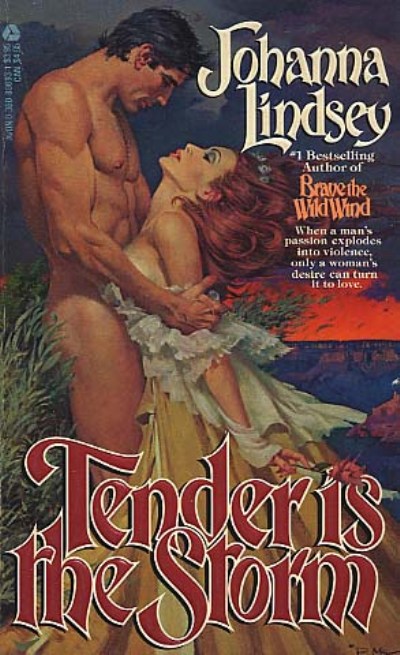
Cover art was a matter of pride for the authors.  Did the people on your cover match the characters in your book?  Sometimes they did, sometimes they didn't.  Were the colors attractive?  Was the lettering for the title (and your name, if large enough) legible?  Did you get embossing or foil or . . . . or anything?  Back in those days, your cover was your main selling tool, and very often authors had little to no control over their covers.  Johanna Lindsey made news when she demanded -- and got! -- a naked man on her cover, by another favorite artist, Robert McGinnis.


But now, as we're more than a decade into the 21st century, we're getting into a whole bunch of new issues with cover art. 

As documented here and here and here on Smart Bitches Trashy Books, cover art gets recycled, sometimes the paintings and sometime with photographs.  Stock photography such as found at IStock.com and 123rf.com and others is inexpensive and plentiful, and a graphic designer armed with Photoshop or any other graphic manipulating software can turn out some pretty cool stuff. 

The problem is, so can anyone else.


Or these:


While the first two examples appear to be books self-published by new authors, the latter two are from authors established in print in the 1980s.  And the worst of it is that both pairs of books were released in the same month on Amazon.

What's an author to do?  Laugh it off and say at least both of them have good taste?