Under normal circumstances, I would not mention a book by name to pan it, and because I hate traditional publishers so much, I don't want to discourage anyone from trying their hand at self-e-publishing.
However.
As I was perusing the recent releases on for Amazon's Kindle platform last Friday night, I started seeing some new titles that really irritated me. Without looking at anything else, without looking at the cover art or who the author was or anything else -- just the titles -- I was annoyed.
Bad Luck Love's Me
and
Knight's of the Realm
and
He concedes to Her Victory
and
A Warriors Romance
Normally I would just have skipped over one or even two of these, but because I had limited my search to only historical romances released on Kindle in the past 30 days, I had a funny feeling there was more to this situation than met the eye.
What I found upon doing some more refining of my search was more than a dozen titles published in the past couple of weeks from a group of seemingly interchangeable authors and editors: Kevin Peters, Sara Rice, Arthur Stone, Rose Stoneman, Jennifer Watson, John Wilson, Robert Wiseman, Rachel Scott, Kelly Dixson, Kevin Wiseman, James Peters, etc. As far as I can tell, the first of these titles was published 27 January 2012. They include not only historical romances but also erotica and what appear to be contemporary stories.
I certainly wasn't going to buy any of them, and as I began reading other people's reviews of them, I realized I wasn't the only person who had complaints. Other readers were remarking on the poor grammar in the titles and horrible formatting of the text.
But then it got worse. One of the Amazon reviewers reported one of the books as essentially stolen -- published on Amazon under another title and with other authors/editors/etc. but originally e-published by someone else. The "someone else" had also put the book on Amazon.
As I began researching further, I discovered that virtually all the books published in the past two weeks by "Kevin Peters" and/or his friends were stolen. They'd all been published somewhere else, including many of them right on Amazon.
Not knowing how else to get the word out, I sent an email to Jane Litte at Dear Author. Within an hour or so, I received an email reply that she had posted about it on the Dear Author website and Tweeted it as well. Within another couple of hours, reviews were being posted to most of the Kevin Peters books, reviews that warned the books were stolen. Some of the authors now have been alerted and have reported the infringement of their copyrights to Amazon.
UPDATE: I sent my original e-mail to Jane Litte at 11:55 A.M. Arizona time. By 7:30 P.M. Arizona time, all the Kevin Peters and Robert Wiseman books had been removed from Amazon.
During additional research after posting this blog, I discovered that "Robert Wiseman" was publishing non-fiction titles that were every bit as stolen as the romance and erotica titles published by "Kevin Peters." Whether they are one and the same, I have no way of knowing. But all the books are now gone from Amazon.
Sunday, February 12, 2012

Friday, February 10, 2012
The Next Effort
As someone once said, there is no rest for the wicked and the righteous don't need it.
I no longer know what "rest" is.
At the beginning of this week, I drove down to Tucson with a friend to take in a couple of the many rock and gem shows. My stated intention was to buy some beads that I wanted to make into rings to sell at upcoming arts-and-crafts shows, and I did that. However, while I was there, my day job called and informed me they would be adding to my daily workload. No, they weren't asking me I wanted extra work or even could fit it into my schedule. There really was no option to decline. They had taken on more work than they had staff to complete it, so existing staff would have to do more, whether they wanted to or not.
Of course, the crucial part of this is that not only does the day job thus take more of my time, time I could have devoted to both my writing and my various craft endeavors, but it also puts additional pressure on my hands and fingers. I've been lucky enough so far to have avoided serious repetitive motion injury pain, but every time I push the work capacity, the hands and fingers and wrists let me know there is a limit. Right now, I'm at the edge of that limit. I will not be pushed over.
So what can I do about it? Not much, but there are options. One is to follow through on my plans to get my other novels onto Amazon and Smashwords.
I unexpectedly received a payment from Smashwords for copies of Secrets to Surrender that had been sold, and while it wasn't a huge payment, it was a reminder that there are people out there who are buying and reading these old books. I need to stop feeling sorry for myself and get busy.
So I'm cleaning up Firefly. With any luck, it maybe be on Amazon and Smashwords in the next couple of weeks.
And maybe I'll make a few rings out of those beads I bought.
Friday, February 3, 2012
Another week ends and another effort begins
Daily life intrudes far too often,, disrupting my intentions and my efforts to escape the humdrum. Mired in the humdrum, I lose perspective. And that's what I need to regain. It's not always easy. The catch-44 of survival -- it's twice as bad as catch-22 -- dominates everything. Not just the sucky day job but the leaky faucet, the dogs' vaccinations, the aging HVAC system, the aging car, the taxes, everything. So I fall into bouts of situational depression, which are not alleviated by Zoloft or Xanax or any of those other miracle drugs that make the lousy world look better even when it isn't.
Not having a partner, I have to deal with all of this by myself. There's no one to talk to about it, no one to offer advice or distraction. So this coming Monday I'm driving down to Tucson with an artist friend, and that 90 minute drive each way will be our opportunity to hash out all our frustrations.
In some ways I shouldn't allow myself to get like this. My financial situation is not dire. My home is paid for and I have the income from social security that is sufficient for survival, if just barely. With the contribution from my roommate for groceries and utilities, plus my income from the day job, I am reasonably comfortable and can put something aside. Not much, mind you, but something. Barring any major unexpected expenses, I'm okay.
But I'm not happy. I'm not doing any of the things that feed my creative soul. That has to change.
So one of the things I did this morning to prime the creative pump, so to speak, was start reading one of the recently-published (by which I mean anything after 2005) historical romance novels I recently downloaded to my Kindle-for-PC. Two pages in, I knew it was crap. TWO PAGES. What is wrong with the romance writing industry? Does no one know how to write any more?
No, I'm not going to tell you what the book is or who the author is or anything else about it. But reading that piece of dreck, even just a couple hundred words of it, reminded me that I need to find a way to do more writing. Yes, this is a distraction, and yes, I should finish this stupid blog and get back to "real" writing.
Oh, and I got my 1099 from Amazon for my 2011 sales of Secrets to Surrender. That was an eye-opener, but at least I ought to be able to improve on that for 2012. Only if I get myself to work!
Thursday, February 2, 2012
So much for resolutions, promises, goals -- all down the toilet
I would like to say that the reason this blog has been inactive for so long is that I've been writing and writing and writing, and managing all the money that's come in as a result of my writing, but that would be a lie, and I really try not to lie except within the framework of fiction. This blog is not fiction.
But it is a confessional of sorts. It is my opportunity to put in the public sphere some of the experiences -- I would never presume to call it wisdom -- that have brought me to whatever point I'm at when I wrote that particular post. Perspectives do change as the experience that informs them changes. In other words, we look at Christmas much differently after we learn the truth about Santa Claus than we did before.
I came to this blog with all the same excitement and enthusiasm and hope that accompanied my long-ago writing endeavors. The dreams I had set aside 15 or more years ago came back to life. I revised and digitally republished one of my books, and I hoped to do the same for the others. I was looking forward to restoring one of those books, Moonsilver, to its original intended length and adding the segment that had been left out when the length was chopped from the 130,000 words of the original proposal to 100,000 via the contract.
Oh, the hopes and dreams and enthusiasm!
But Pocket Books would not relinquish the rights to Moonsilver and held onto them via the contract terms that said they only had to make the book "available" to readers. What appeared to be a print-on-demand edition was offered at Amazon and Barnes and Noble online, at an outrageous price with no cover art until several days after the official "release." Within three weeks, even that much had disappeared from BN.com.
And the sales of Secrets to Surrender languished, generating far less income than anticipated and not quite even recouping the cost of a professionally executed cover.
But other events occurred that chipped away at my enthusiasm, and even at my faith in myself. People I trusted proved to be, shall we say, untrustworthy. I began to doubt my judgment even -- or maybe especially -- when it came to my writing. Was any of it any good? Was I wasting my time? Should I give up my dreams -- again -- and just spend the rest of my life transcribing accident claim statements for insurance companies?
The argument at Dear Author didn't help. The backstabbing by two long-time friends was devastating. I felt as if there wasn't much reason to continue. Just go through life one boring, directionless day at a time. . . . forever.
Has anything changed? No, not really. There have been some small successes, all outside of the writing sphere. I put some of my jewelry and other crafts on an Etsy site and made a few sales. I did well at the art shows I participated in, especially the Canyon Arts Festival in Gold Canyon the end of January. But
the ongoing disappointment and frustration lingered.
I'm not sure how I'm going to shake it off, but I refuse to let Caroline Tolley and Pocket Books defeat me again.
Friday, December 2, 2011
Perspectives on copyright
If you want to understand where this one-sided discussion originated, try here.
First off, what is copyright? We can't have an informed discussion if we don't understand what we're discussing.
Now, I'm not a lawyer and I don't play one on TV and I don't even begin to consider myself an expert. So this is NOT going to be a discussion of Copyright Law, so don't start screaming at me if you're an expert and you think I've got it all wrong. I'm writing about how the non-lawyer general American public looks at copyright, what they think it is and isn't, how they believe it works, and why they think it is or isn't a good thing for them. If you are a lawyer, may I remind you that this is an OPINION piece. One is entitled to one's own opinion, if not to one's own facts. If I get a fact wrong, that's one thing, but you'd better make sure you're correct an error of fact, and not merely an opinion you disagree with.
"Copyright" is a funny kind of term, often misspelled (copywrite or copywright, even copyrite) and often misunderstood, especially when it's violated. The commonly used term is "plagiarism," but the legal term is "copyright infringement." They are not necessarily the same thing.
Some cases of unauthorized copying are just plagiarizing, which is the use of someone else's work and presenting it as one's own. The original work may not even be protected by copyright, either because it's so old as to be in the public domain -- a Tennyson poem or an Austen novel, for instance -- or because it was put into the public domain by the creator.
Plagiarism may not even involve verbatim copying of words. Suppose I wrote a novel about a poor family in Africa who stumbled upon an enormous uncut blue diamond and endured all kinds of tragedies trying to get their treasure to a buyer at a city on the coast and finally, having decided that the wealth the stone would bring wasn't worth all they had lost, including their infant child, I'd be pretty much plagiarizing John Steinbeck's 1947 novella The Pearl. But if I provided enough alterations of the events and added 21st century geopolitics and my own interpretation of events, I probably wouldn't be infringing on the late Mr. Steinbeck's copyright. A retelling of a previously-written story may be plagiarism, may br copyright infringement, may be both, and may be neither!
In other words, plagiarism in and of itself is not illegal. It may very well be, if it also infringes on a copyright, but plagiarism itself is not illegal. Plagiarizing academic work, such as buying a term paper on line and turning it in, may get you an F on your assignment or even kicked out of school, but it is not in and of itself a crime.
Copyright is a legal term, and it means different things in different legal jurisdictions. Each country -- usually countries establish copyright laws -- determines its own laws and enforces them. The law protects the original creator of a work -- written work such as stories, articles, poems, plays; artwork such as paintings, sculptures, or photographs; and performances -- from unauthorized copying of the work.
My purpose here is not to discuss what copyright laws are, how they differ from one jurisdiction or another, or which are right and which are wrong. Instead, I want to explore a concept that underlies and influences but is not the same as copyright law.
All laws, regardless what they regulate, arise from social conditions. They do not precede the conditions. Seatbelt laws were enacted as a response to, well, seatbelts. Seatbelts existed and were in production and in use before there were laws requiring their use. Speed limits were set when there were vehicles capable of going faster than what people considered safe speeds. Legal voting ages weren't determined until voting became possible. Laws always come after the social situation is established.
Now, I know you're going to come up with a list of laws that have been enacted before. . . . something. But before you start showing off your erudition, stop and think about the background to the law you're going to cite. I'll bet you just about anything that there are social and/or cultural conditions already existent that gave rise to that law. And that applies whether the law is one that permits something or one that prohibits something.
The enactment of laws can have an impact on subsequent social conditions, but the laws ALWAYS come second.
Social conditions are very organic, in that they develop over a period of time and are influenced by all kinds of factors, including but not limited to geographic, economic, political, etc. As those factors change, the social conditions change and laws can be and often are changed to accommodate that change.
The whole concept of "ownership" is a good example of the relative nature of legal issues. It makes no difference if we're talking about ownership of real estate or a flock of sheep or a novel. "Ownership" is one concept in and of itself.
"Ownership" can be limited or regulated or even abolished depending on what is owned. But "ownership" itself is a separate concept and is often defined differently in different cultures, and therefore regulated differently depending on how the laws are promulgated.
For example, it is against the law in the United States to own human beings. At one time, however, it was perfectly legal to do so. As social circumstances changed -- whether by the persuasive power of a novel like Uncle Tom's Cabin or through the medium of war -- laws were changed. The laws were not changed in a social or cultural vacuum.
In other countries, however, ownership of human beings as tangible possessions is still legal. The social conditions have not changed to the point of changing the laws in those jurisdictions. One can own, buy, and sell human beings in many countries.
And it is also possible that the social context could change in the U.S. to the point that chattel slavery -- ownership of human beings as property, the legal right to buy and sell them -- is reinstituted as perfectly legal.
Put simply, statutes are not fixed; they are relative to time and location and circumstances.
In most cases in what we consider to be civilized societies, the concept of ownership implies the ownership of something. Ownership does not exist without something to be owned. That something could be a house, a car, a diamond ring, a peanut butter sandwich, a mongrel puppy rescued from the pound, a first edition Lord of the Flies. We don't have much trouble understanding this kind of ownership because the owner -- us -- is easily identified and so is the thing being owned. We may have legal documents to clarify the ownership, such as a deed to a house or vehicle registration, and we may even have to pay taxes to maintain our ownership, but we pretty much accept these concepts as common knowledge.
If we look at those concepts closely, we find that "ownership" is actually a fairly complex issue. It may entail specific legal responsibilities, which are different depending on the object owned. We may not have to pay tax on the peanut butter sandwich, and we may in fact not own it for very long if we consume it, digest it, and, well, you know. We may have to pay taxes on a house or car, and we may have to maintain the house to a specific standard either by local ordinance or Homeowner's Association restrictions. In fact, that HOA may tell us we can't have a dog on the property, so we have to choose to keep the puppy and move, or stay in the house and get rid of the dog.
In other words, "ownership" may very well not be an absolute.
Now, let's look at that first edition copy of William Golding's 20th century classic novel, Lord of the Flies. You own it. You bought it at an estate sale for $5.00 and now you own it. You put it on your bookshelf right next to your first edition copy of Kathleen E. Woodiwiss's The Flame and the Flower.
Your son comes home from school with a library copy of Lord of the Flies. He does not own that book. It's the same novel, by the same author, printed by the same publisher, but the physical personal property that is that book does not belong to him. Your copy belongs to you because you paid for it and bought it and "took title" to it. The copy your son has is borrowed from the legal owner, which is the library.
Therefore, possession and ownership are not one and the same.
Now please remember that I am not -- I repeat in bold NOT -- discussing legal issues but rather the kind of definitions that we all use almost without thinking about them. They've developed over the course of our history as a society, as a group of people living more or less together, interacting in many different ways, even indirectly. Thus, your son uses the library and even though he may not ever encounter 99.9% of the library's other patrons, he is connected to them through the social conventions of using a public library. Everyone understands that the books are being borrowed, not purchased (except when they are put on sale and actually are purchased).
And yes, there are statutes or local ordinances covering the borrowing of books from a public library. I'm not saying there aren't. And sometimes those ordinances may say things that are never or rarely put into practice, like keeping books too long overdue can lead to arrest. I'm only addressing the commonly understood practices we all follow (most of us, most of the time).
Now, you own that first edition copy of Lord of the Flies. Let's say, for purposes of discussion, that you learn it has a value of $500. The library copy your son brought home is not worth $500 even though it is the same novel. There are physical attributes of your copy that make it more valuable than a newer copy. But you don't own $500 just because you own the book. You couldn't deposit it in your bank for $500. All you own is the book. The $500 is an intangible, a potential. You might be able to pawn it for $100, or auction it on eBay for $5,000. But all you own is that single physical copy.
So again, value of the thing owned is also determined by social factors. First, you have to be willing to sell it, and second, someone has to be willing to buy it.
But you also only own that one copy. You do not own the right -- another intangible -- to make copies of it.
Copyright and patent are different but they accomplish similar goals -- they protect the ownership right of a creative artist or inventor to their work. These collections of laws -- which can differ from country to country -- give the creators of "intellectual property" the right to be the only ones to decide whether or not to put their property into the marketplace.
Suppose you invent an electric jacket, like an electric blanket but designed to be worn outdoors and it runs on solar-charged batteries. You apply for and receive a patent on it. You conceived the idea -- even if it utilizes some technology developed by other people -- and the U.S. Patent Office determined that it is a new and distinct product unlike any other before it. You are granted the patent. Ownership of that patent -- which is not a tangible thing but an intangible, a "right" -- allows you to either sell it outright to a manufacturer, who pays you a lump sum and who then takes complete and total ownership and control of it, or to license a manufacturer to produce the jacket. Or you can even manufacture it yourself. You and you alone have the power to make that decision.
If you license Purplenose Outerwear, Inc., to produce the jacket and sell it through various retail outlets, you can dictate some terms of the licensing contract. You may have to give up some control over things like colors of fabric or whatever, but you have the right to reject any offers made by manufacturing companies who want to make and sell your jacket. You own the patent.
If you turn down Purplenose Outerwear's offer and they go ahead and produce a jacket very very similar to yours using virtually identical technology, you can sue them because they had access to your patented idea and they used it without your permission.
Patents generally are granted to cover the invention of physical, tangible things. I have the papers for the patent granted to a distant cousin of mine for his invention of a device used in manufacturing facilities in the early 1900s. Drugs, genetically modified organisms, chemicals, etc. can be patented.
When the creative work is not physical and functional -- that is, designed to perform a specific task in a specific manner, such as keep people warm in cold weather -- then the protection is called copyright. And what a copyright does is grant the creator of the work legal ownership so she/he can decide whether or not to have copies made and distributed, either free or for a price.
Patents have to be applied for and there is considerable expense involved in the application, because there must be a determination that the invention or discovery hasn't been invented or discovered before by someone else. Ultimately, for various reasons, no patent may be granted. The item may have been invented by someone else or it may not be considered enough of an original design to be considered patentable. For instance, a person who invents a motorized toilet bowl brush made from white plastic might be granted a patent because the mechanism is considered new, but the person who "invents" one made of green plastic would not, because that's not a significant modification of the original's function.
In the case of literary works -- novels, poems, plays, etc. -- the legal instrument that provides that protection is a copyright. In the U.S., a copyright does not have to be applied for: As soon as the creator of the work fixes it in a tangible medium -- prints it on paper, saves it to a disk drive, records it on a cassette tape -- that copyright is deemed to have been granted.
The creator can register the copyright -- for a fee -- and registering it gives the owner certain specific rights that are enumerated in statutes. The statutes, of course, are subject to revision, for both registered and unregistered copyrights. For instance, the length of a U.S. copyright has been changed many times. At one time it was only 28 years, and could only be renewed once. That meant some authors whose works were published when they were very young lost ownership of their work within their lifetime.
But even a change like that arises out of considerations explored within the larger society. When few people outlived the copyrights on their works, the 56 year length of a renewed copyright was more than sufficient. But as 15 year olds (and younger) created works, and even 30 year olds lived a lot longer, the length of the legal protection under copyright law was changed. Again, the law was changed to reflect changes in the cultural context of how the ownership of creative works should be defined: Artists should at least be able to retain copyright during their lifetime.
What I hope this illustrates is that copyright law, regardless what it actually is or says, evolves from ideas and concepts and beliefs within the social and cultural context of the society over which the laws are imposed. The laws do not appear out of a social or cultural vacuum.
As the cultural context changes, sometimes due to technological changes, the laws may or may not keep up. We've seen in just the past few years how the issue of copyright -- ownership of creative works -- has been impacted by electronic reproduction technology. It was bad enough in the days of vinyl records, AM radio, and reel-to-reel tape recorders, but at that time there was little opportunity for any one individual to make or distribute many multiples of a copyrighted record. And the cost involved -- purchase of the recorder and tape -- was somewhat prohibitive, because it was actually cheaper to go out and by the record for $1.00. (And yes, even in the days when minimum wage was only $1.00 an hour, and babysitting paid half that!)
But technology advanced quickly and for all types of "publication," duplication and distribution without the copyright holder's permission became easy and affordable. Why pay for a CD or DVD or even for a legal download to your iPod if you could get it free from a sharing site? It may have been the very ease of duplication and distribution that prompted a shift in public perception of who had the rights to what, but over the past few years, there has been a shift. The consumers of intellectual property have claimed a kind of ownership, and that ownership has been facilitated by technology.
The technology, especially the software, that facilitates the duplication is itself often an intellectual property covered by the laws it is circumventing!
That technology and its ownership have also contributed to a cultural perception that ownership of intellectual property is not a public good.
When people like Bill Gates and Steve Jobs and other technology billionaires use their ownership of copyrights to amass huge sums of wealth and prosecute anyone, even individuals who could not afford to buy Microsoft or Apple products legally and therefore would never be paying customers, those billionaires are seen by many to be parasites and bad owners. They give copyright and intellectual property, as concepts, a bad name. As rock stars become millionaires -- regardless whether their fortunes come from sales of recordings or from ticket sales to performances or from licensing of merchandise -- fans feel they have the right to free copies of recordings because the artists already have so much.
When it comes to writing, and especially in romance fiction, Big Name Authors like Rebecca Brandewyne's crusade to demand royalties from used bookstores and libraries added to a negative perception within the public of owners -- if not ownership -- of intellectual property. Brandewyne did not feel purchasers of her books should have the right to trade or resell those copies without her being paid a royalty. Even though she had been paid a royalty by the publisher for each printed copy of the book sold, she also wanted another royalty each time the used book was resold by a book exchange or other reseller, as well as each time it was lent by a library. Many readers came to see Brandewyne's attitude as nothing short of greedy.
And of course there have always been resellers of merchandise, everything from used cars to secondhand clothing. The original manufacturer never receives any payment on the resale, any more than a developer or builder is paid when a house is resold.
One of Brandewyne's justifications came from her experience with the music recording industry, where royalties were paid to performers, composers, and lyricists based on radio broadcast performances. The recording industry, through ASCAP, BMI, and other registries, was able to attach royalty payments as a condition of station licensing. In part, this was possible because radio and recording reproduction via the phonograph both were fairly new technologies that developed at about the same time, and the artists who had a vested interest in obtaining royalties from broadcasts of their recorded performances were able to do so through de facto unionization. Many musicians were already unionized, so this was the next logical step. And because of federal licensing requirements for broadcast media -- first radio, and then television -- there were enforcement procedures and provisions already in place.
Unfortunately for Brandewyne and other writers like her, print publishing and used bookstores were already a long-established feature of society, and the copyright laws that had long been on the statute rolls could not be changed to cover existing copyrights without disrupting the established pattern of commerce. How would booksellers and libraries be able to charge readers and pass along royalties based on copyrights that had expired or had been granted before the lending/reselling royalty law was enacted? The logistics of enforcing such a law would be enormous, compared to the already regulated licensing of radio and television stations and eventually cable networks.
There was also a perception -- especially within the romance-reading community -- that the authors were making a whole lot of money already and didn't need any more from the sale of used copies of their books via small private mom or pop book exchanges or public libraries. The whole point of public libraries had always been to provide reading material for those who might not be able to afford to buy it. (And there has never been "means testing" for library cards.)
What was happening, at least in the U.S., was that copyright was being transformed from a protection of the artist's labor investment to a protection of the artist's property ownership. And property, as a tangible physical entity, becomes divorced from the human creator. The U.S. culture is strongly oriented toward property rights, and this goes back directly to the Calvinism of the original emigrants from 17th century England, and includes, in the concept of grace, a dismissal of labor.
In other words, Calvinistic doctrine says you can't work or earn your way into heaven; God alone grants "grace" and wealth is a sign of that grace. (I became a Presbyterian as a young adult and this made no freaking sense to me; I didn't stay Presbyterian very long.)
Whether the European culture, with much more value accorded to labor, is responsible for differences in copyright law there which grant artists a bit more control over their rights even in publishing contracts, I don't know, simply because I don't profess to know anything at all about their copyright law. But I think it's important to note that there are differences, that intellectual property laws are not the same everywhere and that this indicates some sort of distinct evolution of the legal concepts that is dependent on social and cultural differences.
How would the American public view copyright, especially in this age of digital reproduction of movies, music videos, television shows. musical and theatrical performances, art (at least the two-dimensional kind) and literature in all forms?
I believe that right now -- December 2011, since that's when I'm writing this -- copyright is looked upon as a "thing" that is very close to being tangible because it is embodied in tangibles, whether they are books or DVDs or MP3 recordings. They are collectively referred to as "intellectual property," as if they are somehow akin to a car or a refrigerator or even a house.
Especially in the minds of those who have grown up with this advanced technology that allows them to duplicate and distribute "intellectual property" with relative ease and without much expense, ownership of intellectual properties seems to transfer with the sale of the copy, completely divorced from the concept of copyRIGHT. The very term "property" connotes something tangible and transferable.
We used to call them "works." A "work" of art. Literary "works." "Opera" literally means "works," as the plural of "opus" or work, the Latin origin of which should be familiar in our word "operate." Linguistically we connected the product to its producer, rather than separating it from her or him and making it a semi- or quasi-tangible "property."
Needless to say, this is not what has actually been done, but this is how we perceive things and then begin to behave in relationship to them. By equating creative works with "property," we have divorced them in our minds and in our behaviors from the labor that produced them. We no longer think of the work that went into creating them. We no longer think of the hours spent writing the novel or doing the research for it, or negotiating with the publisher for a fair compensation. Instead, we see "intellectual property" and we think purchasing a copy of the book grants us title to it.
The U.S. is particularly, and perhaps peculiarly, property-conscious nation. Owners of property often behave as if they have no responsibility to their neighbors or even to distant people who may be affected by how these owners use their property. "A man's home is his castle" has somehow morphed into "It's mine and I can do whatever I want with it!"
Work is not revered in this culture to the same extent that property and unearned wealth are. The origins of this cultural attitude are long and deep in our unique American history. This viewpoint has strengthened in the past generation or so as we see more and more "work" disconnected from "products." Our American economy makes fewer and fewer things. We know that the workers who make our televisions and our computers, our iPods and Androids, our microwaves and sweatshirts, are poorly paid and in distant countries. We do not value them, and we do not value work.
We have adopted, as consumers, an attitude that the more cheaply we can get something, the cleverer we are. Getting something "wholesale" used to be the mark of cleverness, but now it's getting it free. We don't see that as depriving someone of the fair payment for their labor, because we don't see labor as productive.
So what we've ended up with is a sense that copying a copyrighted work becomes our right as a consumer. We do not want our digital music or our digital movies or our digital books to belong to anyone but us. The creators of those "intellectual properties" are no longer due fair compensation for their labor, because it's been turned into a commodity that belongs to us.
One of the comments on that Dear Author thread came from someone who called him/herself "eggs." Eggs compared my ire at not getting the rights back to my books to my being upset that the purchaser of a house I'd sold them 18 years ago wouldn't give it back to me.
Wednesday, November 30, 2011
Every day, in every way, I hate them more and more
So. Yesterday I told you about some of the ways Simon & Schuster has screwed me over with Touchstone, the second of the two historical romances I wrote and published with them in the mid 1990s.
But they are also screwing me over with the first book I did for them, Moonsilver, which was published in 1995. I offered some of Moonsilver's history here and now I'm going to add more details and bring that saga up to date. (And yes, I write long blog posts. I wrote long books, too. Deal with it.)
When I was introduced to agent Cherry Weiner at the 1991 RWA conference in New Orleans, she told me categorically that she was not accepting any new clients. Even so, she agreed to look at some of my proposals -- brief outlines and a few sample pages at most -- over lunch. Before we left the restaurant, she had asked to represent me, primarily on the strength of one of the proposals, Moonsilver.
At that time, the first of my three books for Zebra, titled Secret Fires, had just come out and I was working on the second, which would be published the following year as Desire's Slave. I have since revised and published that as a digital edition titled Secrets to Surrender. Both books were purchased on single-book contracts, so I had very little track record and nothing in the way of significant sales. Cherry would have to sell any of my proposals on their own merits, not on mine. I will give her full credit for having that much faith in me, and in the books.
She was most taken with Moonsilver, which had what I thought an interesting and maybe even a unique premise: The hero and heroine each adopt not one but two disguises through the course of the story and yet fall in love each time without recognizing each other. Far-fetched? Of course! But isn't romance fiction kind of far-fetched anyway? The challenge to me was to make the far-fetched premise believable.
As Cherry's marketing plan for the various proposals developed, she made it clear that she did not want Moonsilver to go to Zebra because she felt they could not and would not do it justice. I would have to fulfill an option clause on Desire's Slave, but Cherry was not going to send in Moonsilver.
Over the next several months, I completed the book for Zebra and Cherry sent them another of the original three proposals, which I had originally titled Shadows by Starlight, as the option. In August 1992, Zebra offered me a two-book contract, of which Shadows would be the first. I would have a new editor at Zebra for this book, John Scognamiglio, who is now Editor-in-Chief at Kensington/Zebra. I'm quite sure John doesn't remember our lunch at the sidewalk cafe at the Palmer House during the 1992 RWA conference in Chicago, but I do.
I know, you're wondering how I got sidetracked from writing about Moonsilver to going into all this detail about books I sold to Zebra. Patience, Grasshopper.
Shortly after I got the two-book contract offer from Zebra, I received a rejection letter from editor Caroline Tolley at Pocket Books. As I mentioned in the previous blog post, the letter came to me with a note from agent Cherry Weiner: "Frame this."

Scognamiglio is the one who bought Shadows and offered the two-book contract, but he did not remain my editor for very long. After Shadows entered the editorial process, Walter Zacharius hired Denise Little, former romance buyer for the B. Dalton chain (iirc), as an editor, and I was shifted from Scognamiglio to Denise Little. Denise had a fairly light touch as far as making changes to my work, but what she did change sometimes made little sense. For instance, there is a scene in the book in which a character aims a rifle at another character. No details are provided about the firearm, but it is identified as a rifle several times. When the weapon is discharged, Denise for some reason or other changed one line from


But they are also screwing me over with the first book I did for them, Moonsilver, which was published in 1995. I offered some of Moonsilver's history here and now I'm going to add more details and bring that saga up to date. (And yes, I write long blog posts. I wrote long books, too. Deal with it.)
When I was introduced to agent Cherry Weiner at the 1991 RWA conference in New Orleans, she told me categorically that she was not accepting any new clients. Even so, she agreed to look at some of my proposals -- brief outlines and a few sample pages at most -- over lunch. Before we left the restaurant, she had asked to represent me, primarily on the strength of one of the proposals, Moonsilver.
At that time, the first of my three books for Zebra, titled Secret Fires, had just come out and I was working on the second, which would be published the following year as Desire's Slave. I have since revised and published that as a digital edition titled Secrets to Surrender. Both books were purchased on single-book contracts, so I had very little track record and nothing in the way of significant sales. Cherry would have to sell any of my proposals on their own merits, not on mine. I will give her full credit for having that much faith in me, and in the books.
She was most taken with Moonsilver, which had what I thought an interesting and maybe even a unique premise: The hero and heroine each adopt not one but two disguises through the course of the story and yet fall in love each time without recognizing each other. Far-fetched? Of course! But isn't romance fiction kind of far-fetched anyway? The challenge to me was to make the far-fetched premise believable.
As Cherry's marketing plan for the various proposals developed, she made it clear that she did not want Moonsilver to go to Zebra because she felt they could not and would not do it justice. I would have to fulfill an option clause on Desire's Slave, but Cherry was not going to send in Moonsilver.
Over the next several months, I completed the book for Zebra and Cherry sent them another of the original three proposals, which I had originally titled Shadows by Starlight, as the option. In August 1992, Zebra offered me a two-book contract, of which Shadows would be the first. I would have a new editor at Zebra for this book, John Scognamiglio, who is now Editor-in-Chief at Kensington/Zebra. I'm quite sure John doesn't remember our lunch at the sidewalk cafe at the Palmer House during the 1992 RWA conference in Chicago, but I do.
I know, you're wondering how I got sidetracked from writing about Moonsilver to going into all this detail about books I sold to Zebra. Patience, Grasshopper.
Shortly after I got the two-book contract offer from Zebra, I received a rejection letter from editor Caroline Tolley at Pocket Books. As I mentioned in the previous blog post, the letter came to me with a note from agent Cherry Weiner: "Frame this."

I didn't frame it, but I did pin it to my bulletin board right next to my desk.
But her words were lost in the explosion.
to
But her words were lost in the explosion of the shotgun.
I don't know a whole lot about guns, but I know enough to know a rifle and a shotgun are two different things. Denise, who would later claim to be a native Texan who knew guns, changed the line back to the original at my insistence.
I point this out as an example of the kind of editorial fiddling that, in my personal opinion, made no sense except as an exercise of editorial power. The change created an inaccuracy for one thing, but even if Denise had simply added "of the rifle" to the sentence, it would have added nothing of substance. I felt that she was doing it because she could. And I resented not only that she was exercising this power for no good reason, but even more so because her change was inaccurate and actually made the book worse instead of better.
Most of her other changes were innocuous, and I lived with those that did not detract from the novel or reversed those that did. I was satisfied that Denise Little had not made the book worse. I waited to see what kind of cover art she was going to give it.
She told me on the phone that it would be a step-back cover, which for those who don't know is the kind that consists of a slightly narrower outer cover -- the right edge being "stepped back" from the edge of the book -- and an inner cover. The back, she told me, had the characters embracing under a gaslight. This made no sense, since there were no gaslights in the story and the title was Shadows by Starlight not Shadows by Gaslight. But whatever. I had no control over it and I would take what they gave me.
And this is what I got:

No step-back. No lovers under the gaslight. No lovers, no people at all. Just a lot of pink flowers -- there are none in the book -- and the gaslight that wasn't there either.
Needless to say, I was ticked. But I couldn't complain, not even point out that either Denise had told me something she knew wasn't accurate, or she herself didn't know what was going on. Either way, my distrust of editors had grown.
By this time, however, I was engaged in writing the second of the two books on that contract, which I had titled Escape to Ecstasy. Denise didn't like that title; she claimed it was the title of a very well known and notorious gay porn video. Cherry was continuing to market the various proposals I'd been sending her way and getting the usual rejections.
But she was also keeping tabs on Caroline Tolley and the schedule at Pocket, and eventually negotiations were opened with an anticipated offer for Moonsilver. One of the conditions, however, was that I cut ties with Zebra. Escape to Ecstasy was incomplete, and by the time the issue with Pocket came up, I didn't have much enthusiasm for it anyway. Nor did I have much enthusiasm for working with Denise Little. Denise by that time was well into her new "Denise Little Presents" line, and I felt she didn't have much interest in me. So when Cherry suggested that I buy back that second book and cancel the contract, I agreed. It was a huge financial sacrifice for me at the time, returning the $1,750 advance Zebra had already paid me, but for the chance to be with Pocket Books, I did it.
I received the phone call from Cherry Weiner on the afternoon of 6 December 1993 with the details of the offer of a two-book contract, for Moonsilver and an as yet to be determined historical romance. On the morning of 7 December 1993, Cherry called Caroline Tolley with my acceptance of the deal.
That afternoon, as I've detailed, was the Long Island Railroad shooting, which left Caroline understandably distraught, so it was several weeks before I received the actual contract. It contained some . . . surprises.
Moonsilver had always been intended as a longer historical romance, roughly in the neighborhood of 130,000 to 140,000 words. The contract called for a manuscript length of only 100,000 words. I questioned this, but Cherry said to go ahead and sign it, send in a manuscript of whatever length I needed to tell the story, and either let Caroline help me edit it down or dazzle her with the brilliance of my writing so that she accepted the longer length.
Having just come off the experience with Denise Little, I was not confident that this would work out.
Almost as soon as the editing process began, the relationship between myself and Tolley began to disintegrate. No matter how hard I tried, I couldn't figure out how to do what she wanted me to do, and when I asked her for suggestions, she was not forthcoming.
As an example, she wanted additional description in the opening scene of the heroine's appearance, because she is in the first of her disguises. Caroline pointed out that I began the scene as if the heroine actually were the character she was masquerading as, and that might confuse the reader, so even though I had reasons for writing the scene that way, I was amenable to changing it and avoiding reader confusion. I did not believe my precious words were carved in stone, and I knew I was capable of the usual author's blindness.
But what I didn't understand was how to put in more description the way Caroline wanted it done. She would not let me use the trite device of having the heroine see her reflection in a mirror or window, but it had to be done within the heroine's point of view. Therefore I could not use another character to provide the description. Nor did she want me to have the character thinking about her appearance. As we were talking about this on the phone, I came right out and asked Caroline what suggestion she had for how I could get additional physical description in, since she had asked for it, without resorting to any of those devices. At that point she exclaimed, without sarcasm, "Then we just won't have any description at all," as if it weren't really necessary, even though she had just demanded it.
There was another scene, much later in the book, in which the hero has been falsely imprisoned in the infamous Newgate in London. He was injured during his "arrest" and has fallen seriously ill as a result of conditions in the prison. He is near death when his lawyer visits him and offers him a chance to be released if he will marry a woman, unknown to him, who is in need of a husband. Caroline wrote to me, "Make clear that marrying a stranger is preferable to remaining in jail."
(The scene between the lawyer and the hero as suggested by my AOL writing buddy Kathie Seidick is hilarious, and someday maybe I'll post it, but she told me it had to be anonymous. . . . .)
(The scene between the lawyer and the hero as suggested by my AOL writing buddy Kathie Seidick is hilarious, and someday maybe I'll post it, but she told me it had to be anonymous. . . . .)
Somehow or other, I got through what I called "the edit from hell" and finished the book, but I was not satisfied with it. Caroline refused to budge on the word length, but the manuscript ended up right around 115,000 words only because I didn't write one whole section.
I was stressed out dealing with a demanding but not helpful editor, and I had fallen behind schedule on the delivery of the book. I got a short extension and completed it, but only at the expense of the story segment that would have explained a major subplot that underlay the second set of disguises the lovers adopt. As far as I was concerned, that subplot remained unresolved and much of the ending made no sense. Though I had tried to tie up that bundle of loose ends as best I could, the result was unsatisfactory to me.
But the book was done, and in the summer of 1994 I went to the RWA national conference in New York all excited about meeting Caroline and seeing what she called "the cover to die for" that Moonsilver would be getting.
When she told me that over the phone, I had an immediate flashback to all the pink flowers and gaslights of the book Denise Little had titled Starlight Seduction.
Caroline had asked me, early in the production, if I had any suggestions regarding the cover art for Moonsilver. Since the hero is, part of the time, a notorious highwayman, I offered the comparison to The Scarlet Temptress by Sue Rich, because I knew Sue was also one of Caroline's authors, and I had liked the cover art on that book, with the horse, the moon behind the stylized tree, and so on.
Later, Caroline had asked me if there were some significant inanimate objects in the story that could be depicted on the cover, in part to avoid the typical "clinch" cover, which was sort of passing out of favor a little bit in the mid 1990s. All I could come up with were the sapphire necklace, the highwayman's mask, and a pistol. There really weren't any other objects that had any significance.
The necklace is described in the text as an extravagance of eight oval sapphires surrounded by diamonds with a single larger sapphire pendant, all "set in a gold so pale as to be almost silver." The highwayman's mask is a single strip of black silk cloth with holes cut for the eyes. The pistol, well, could be anything because it only appears briefly.
Much of the action in the story actually takes place at night, in the dark, so I had visions of a dark, glittering cover as befit the title.
I won't even go into the events that preceded my visit that summer morning to the Simon & Schuster offices for the reception at which Caroline would show me "the cover to die for." But there I was, surrounded by authors and staff members and Caroline handed me the proof.

I was quite literally speechless. The necklace was all wrong. There were no pink flowers. Everything looked like it was under water. And my highwayman would not have been caught dead in a Mardi Gras mask!
I knew the book would never sell. I knew the story had been gutted by the length limitations and the absurd editing that had stifled my creative energy. More than anything, however, I knew this cover was a killer.
I'm quite sure Caroline was aware of my disappointment, and I think she even said something to me much much later. But somehow or other I survived the S&S reception and then headed back to the Marriott Marquis hotel where the conference was held. As it turned out, I ended up walking back with Judy Spagnola, who at that time I believe was one of the head buyers for the Waldenbooks chain. We had never met before and I'm not sure I've ever spoken to Judy since that stroll through midtown Manhattan on a splendid summer morning.
But as I explained the situation to her, she asked to see the cover and then said, "Do you want my honest opinion?"
"Yes, of course I do!" I said, hoping she would tell me it was a great cover and would sell a bazillion books even though I knew otherwise.
What she said was, "It sucks. This is a terrible cover. It will kill your book."
And of course it did.
Over the course of its natural shelf life, Moonsilver sold about 15,000 copies. That's nothing to brag about. As far as I can tell there have been no reprints, no reissues, no "special sales" to discount stores.
I've just gone back and looked through some of the correspondence between Caroline Tolley and myself, and even 17 years later it is painful. I couldn't read all of it, and even the little bit I did skim brought tears to my eyes.
Here's the thing -- I loved this book. I think Cherry Weiner knew that when she read the synopsis and opening pages. And I think it could have been a truly memorable book. Not necessarily a best-seller, but one of those stories that stays with the reader long after the last page is turned. Caroline Tolley's inflexible demands -- later, when it's less painful, I'll pull out some quotes from her letters -- destroyed not only the book but me as a writer.
And now Pocket Books continues to destroy this book. All I asked them for was the return of the rights they haven't exercised for 16 years, so that I had the right to publish my own digital version of Moonsilver. I didn't think that was too much to ask, but apparently they did. Even though they will probably sell none and make nothing off the sale of obscenely over-priced print-on-demand copies of Moonsilver and readers won't buy them, Pocket Books will selfishly and vindictively prevent me from publishing that affordable digital version.
As far as I've been able to determine, they have not done this to any other author.
I hate them. If anything, I hate them more than when I started this post.
Tuesday, November 29, 2011
Why I hate publishers even more than I did a month ago
In the month or so since my last post, I've learned a few things.
First of all, let's put this issue of the 2004 "first edition" of Touchstone to rest. I ordered one from an Amazon-affiliated reseller, and it arrived in pristine condition. Spine is uncreased, corners are sharp, edges are not yellowed. I have copies of the genuine first edition that are in similar condition.
However, this new acquisition is not the same.
To begin with, the front cover does not have the embossed lettering of the title and my name. The colors are a tad bit faded, as if the inks were slightly watered down. And there is no Pocket Books logo on the front cover.
The back cover is lacking an ISBN and corresponding barcode; the 2004 edition has only a UPC barcode. And where the original indicated on the pricing barcode a cover price of $5.99 (U.S.), the reissue indicates that the cover price is now $1.00.
The spine of the 2004 release has no pricing information at the bottom. The 1996 printing shows that the retail price is $5.99 in the U.S. and $7.99 in Canada, followed by the ISBN.
So much for the exterior. Inside the 2004 edition, all advertising for other Pocket Books authors and titles is gone. The inside of the original front cover contained a promotion for my other Pocket title, Moonsilver; inside the back was a brief author's bio. The last page of the original edition was an ad for Judith McNaught's many Pocket Books titles. All three of those items are missing from the 2004 printing.
With one exception, everything else about the content of the novel itself appears to be identical to the 1996 first printing. The only other change is on the copyright page.
The 1996 printing includes the line:
First Pocket Books printing March 1996
followed by the string of numbers that usually indicate which printing; in this case 10 9 8 7 6 5 4 3 2 1 are all there.
The 2004 batch has altered that line to read:
This Pocket Books paperback printing September 2004
followed by the same string of numbers right down to 5 4 3 2 1.
But the book is not -- NOT -- a first edition. Not by any stretch of the imagination.
Simon & Schuster collected approximately $14,000 on this printing of roughly 28,000 copies. Someone purchased all 28,000 copies on a non-returnable basis for roughly 50 cents each and sold -- or tried to sell -- them for $1.00 each. I'm guessing it was one of the discount retailer chains, commonly referred in the generic as The Dollar Store, but I really don't know. I don't care. I do know that my royalty account at Simon & Schuster was credited with $625.05 for the "special sale" of 27,780 copies of Touchstone.
Touchstone sold fewer than 10,000 copies on its initial print run. I have absolutely no idea why any retailer would want 28,000 more copies of it, but apparently Simon & Schuster thought they could make money off it even at 50 cents per copy. As a former cost accountant, I can only take this to mean that the actual cost of printing and binding and shipping a mass market paperback in 2004 was less than 50 cents a copy.
I have no idea what the initial print run on Touchstone was, but considering how few copies it sold, I can't imagine S&S was willing to print 28,000 more copies at a loss. Obviously they had no editorial costs, no typesetting cost, not even any artwork cost. Just print and bind and ship.
Okay, so that's the 2004 edition of Touchstone. Not a first edition at all.
First of all, let's put this issue of the 2004 "first edition" of Touchstone to rest. I ordered one from an Amazon-affiliated reseller, and it arrived in pristine condition. Spine is uncreased, corners are sharp, edges are not yellowed. I have copies of the genuine first edition that are in similar condition.
However, this new acquisition is not the same.
To begin with, the front cover does not have the embossed lettering of the title and my name. The colors are a tad bit faded, as if the inks were slightly watered down. And there is no Pocket Books logo on the front cover.
The back cover is lacking an ISBN and corresponding barcode; the 2004 edition has only a UPC barcode. And where the original indicated on the pricing barcode a cover price of $5.99 (U.S.), the reissue indicates that the cover price is now $1.00.
The spine of the 2004 release has no pricing information at the bottom. The 1996 printing shows that the retail price is $5.99 in the U.S. and $7.99 in Canada, followed by the ISBN.
So much for the exterior. Inside the 2004 edition, all advertising for other Pocket Books authors and titles is gone. The inside of the original front cover contained a promotion for my other Pocket title, Moonsilver; inside the back was a brief author's bio. The last page of the original edition was an ad for Judith McNaught's many Pocket Books titles. All three of those items are missing from the 2004 printing.
With one exception, everything else about the content of the novel itself appears to be identical to the 1996 first printing. The only other change is on the copyright page.
The 1996 printing includes the line:
First Pocket Books printing March 1996
followed by the string of numbers that usually indicate which printing; in this case 10 9 8 7 6 5 4 3 2 1 are all there.
The 2004 batch has altered that line to read:
This Pocket Books paperback printing September 2004
followed by the same string of numbers right down to 5 4 3 2 1.
But the book is not -- NOT -- a first edition. Not by any stretch of the imagination.
Simon & Schuster collected approximately $14,000 on this printing of roughly 28,000 copies. Someone purchased all 28,000 copies on a non-returnable basis for roughly 50 cents each and sold -- or tried to sell -- them for $1.00 each. I'm guessing it was one of the discount retailer chains, commonly referred in the generic as The Dollar Store, but I really don't know. I don't care. I do know that my royalty account at Simon & Schuster was credited with $625.05 for the "special sale" of 27,780 copies of Touchstone.
Touchstone sold fewer than 10,000 copies on its initial print run. I have absolutely no idea why any retailer would want 28,000 more copies of it, but apparently Simon & Schuster thought they could make money off it even at 50 cents per copy. As a former cost accountant, I can only take this to mean that the actual cost of printing and binding and shipping a mass market paperback in 2004 was less than 50 cents a copy.
I have no idea what the initial print run on Touchstone was, but considering how few copies it sold, I can't imagine S&S was willing to print 28,000 more copies at a loss. Obviously they had no editorial costs, no typesetting cost, not even any artwork cost. Just print and bind and ship.
Okay, so that's the 2004 edition of Touchstone. Not a first edition at all.
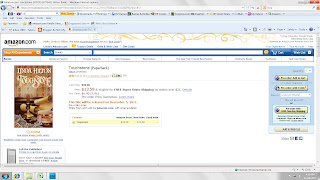
But now we get to the 2011 edition. The one that's on Amazon for $13.59 and due to be released next Monday, 5 December 2011. Still no way to "review" this one, even though an old review has been attached to it -- one presumes by Amazon and not S&S, because the "review" is pretty stupid.

There's a screen capture as it looks today -- 29 November 2011 -- with the ridiculous list price of $19.99 discounted to $13.59. The listed author's name is incomplete, even though it's quite obvious from the cover of the book -- unchanged since 1996 -- what my name is.
Barnes&Noble, of course, is no better, and they don't have the cover art up yet.
I should note, too, that Amazon didn't have a cover posted either until just the past couple of days, and it's not like it's NEW cover art or anything.
I can only believe, absent any notice to the contrary from Simon & Schuster, that this is "print on demand" edition, which means they don't have any financial investment in this at all. But this POD edition makes the work still "available" to the reading public, though at an outrageous price no one is going to pay. People weren't even willing to pay $1.00 in 2004 to snap up all those cheap copies, so why in heaven's name would anyone plunk out more than $13.00 in 2011?
My day job demands my attention right now or I'd start going through my own inventory to find other books that were published by Simon & Schuster in the mid 1990s to see how many other authors are being treated this way. S&S can't think that they need to hang onto my rights because I'm going to be famous one day and they'll make bazillions off my backlist (there are only two titles in that backlist anyway).
No, this is sheer vindictiveness. They can't put out a digital edition without negotiating "in good faith" the royalty rate with me, and they clearly don't want to do that and run the risk that I'll demand a "fair" rate. So rather than give me the rights back, which I have asked in writing for, they are making this absurd edition "available" and denying me my copyright.
I can't afford a lawyer to address this, and I'm not a member of NINC or even of RWA, so I don't have them to help. (Not that RWA has ever done much for me in the past, which is why I haven't belonged for over 10 years.) But unless and until Simon & Schuster/Pocket Books either plays fair or gives a reasonable explanation for why they're doing this, I will not shut up about it.
I hate publishers.
Subscribe to:
Posts (Atom)
But by suggesting that I had no right to request -- requesting is not the same as demanding -- return of the rights in the event Pocket allowed them to fall "derelict" is further failure to think through that hypothesis, because the reversion of rights clause essentially, to use eggs' analogy, requires the purchaser of the spec house to keep it from falling derelict, and if they don't, then the house/copyright reverts to me under the terms of the contract.
But therein lay a good part of the problem with Jane Litte's whole argument/disagreement with me. She set up her thread to cover a variety of topics, ranging from plagiarism/copyright infringement to my particular experience with Pocket Books. For whatever reason, she seemed -- in my perception anyway -- to have assumed that when I engaged the poster dick on the issue of property rights and plagiarism, that I must be speaking in terms of my copyright and my contract, when in fact that was not the case at all. Later in the thread, Courtney Milan (who I believe is also a lawyer) chimed in trying to tell me what I was thinking, and subsequently a few others.
However, the two subjects were not inherently linked. My comment to dick and the subsequent explanations and defenses were, in my mind, quite separate from the discussion with eggs regarding my particular contract. It just so happened that I happened to have an opinion on both subjects.
So if Jane or Robin/Janet (who appears to be a law student and, like Jane, apparently can't wrap her head around anything regarding copyright in any terms other than Legal with a capital L) drops in here, I do hope they'll take the time to think through their responses, even if they don't write anything. The original Dear Author thread was on several other subjects besides my contract with Pocket and plagiarism. Just because I happened to be the principal in one of those subjects doesn't mean I was obligated to drag those issues into a discussion of the other subject.
And for the record, on a third issue in that thread, whether it made sense for an author to charge more for a DRM-free copy of her digital book, was I the only one who thought, well, duh, of course you charge more for something when you pretty much know people want the DRM-free copy so they can sell it to someone else and you the author won't get anything for it!
Or am I missing something here?