This is a short update to a previous post about plagiarizing reviews.
As I said at the end of that post, I will never ever forgive someone who steals another's words. And if it's possible for one kind of theft to be worse than another, then I guess the theft of reviews is even lower than theft of a book or story or other original work.
Posting a stolen review on Goodreads or Amazon or your blog or anywhere else has absolutely no excuse. None.
There can sometimes be some justification for stealing bread or stealing money or stealing ... whatever, on the basis of need. That, after all, is at the heart of so many classic stories, because there is an underlying injustice that creates the need that can only be satisfied through theft.
What is the underlying justification for stealing a review, for crying out loud? There is no compensation involved to either party. Is it ego, a need to be recognized and praised for one's contribution to the already enormous mountain of readers' responses to published works? If so, then why steal? Do you think you're not going to be found out?
Perhaps it is a genuine mental illness that requires professional treatment. Perhaps. Perhaps. If so, then the person needs to find professional help -- or a friend or loved one needs to find it for her -- and get the problem taken care of.
Stealing a review is a conscious act. It's not an accident, not when it happens a dozen times or more. There is premeditation in the setting up of a user account, selecting the books to be "reviewed," and then choosing which reviews to actually steal.
How much more unforgivable can the theft be than when it is committed by a writer? Does that writer not value her own words? How would she feel if her words, her creation, her thoughts, her soul were stolen from her?
No doubt the account will be deleted from Goodreads, If the reviews that have been stolen were also published elsewhere, on a blog or on another website, they will be identified and removed also.
When I wrote in another previous blog post that it's okay to write a review out of anger or revenge or spite, I meant it. Sometimes there are authors whose behavior outside the pages of their books is so offensive that the reader just can't set it aside. For me, one of those behaviors is stealing another person's words. For me, that is simply not forgivable, and any author I learn has done it will be fair game for my revenge review.
DO NOT STEAL. Period.
Showing posts with label copyright infringement. Show all posts
Showing posts with label copyright infringement. Show all posts
Wednesday, July 17, 2013

Saturday, July 13, 2013
...And just a few discouraging words -- for reviewers
DON'T STEAL.
If you wanta be mean and nasty, if you wanta lie and cheat, if you wanta slash and burn, that's okay. You hated the book, okay. You don't like the author's politics or choice of spouse, okay. You'll never read the book but you'll give it 100 stars anyway, fine.
But do not steal another reviewer's review. Just don't do it.
It's plagiarism, it's copyright infringement, it's stealing the soul of the person who wrote, who owns those words.
I love words, I love writing, and even if I don't like what they write, I have at least an understanding of what a writer goes through. Writing a review of someone else's writing is still writing.
DON'T STEAL.
I will not forgive you. Not ever.
If you wanta be mean and nasty, if you wanta lie and cheat, if you wanta slash and burn, that's okay. You hated the book, okay. You don't like the author's politics or choice of spouse, okay. You'll never read the book but you'll give it 100 stars anyway, fine.
But do not steal another reviewer's review. Just don't do it.
It's plagiarism, it's copyright infringement, it's stealing the soul of the person who wrote, who owns those words.
I love words, I love writing, and even if I don't like what they write, I have at least an understanding of what a writer goes through. Writing a review of someone else's writing is still writing.
DON'T STEAL.
I will not forgive you. Not ever.
Saturday, June 15, 2013
How to start taking ownership of your stolen words
DISCLAIMER: I am not a lawyer and the following should not be taken as nor substituted for professional legal advice. This is only a compilation of information that is readily available online.
If you think someone is publishing your work without your permission, there are steps you can take to protect yourself before -- but not instead of -- going to a lawyer.
If the infringing work has been published on Amazon by the Kindle Direct Publishing program (KDP), you can notify Amazon directly.
On the book's Kindle listing page, all the way down at the bottom, past the reviews and everything else, is a box with four Feedback options.

The fourth option is "Do you believe this item violates a copyright?" If you believe YOUR work has been infringed, click here for additional information. Remember: You cannot report a violation of anyone else's copyright, only your own. And no one else can report a violation of your copyright; you must do it yourself.
Clicking on the link will take you to the page on Amazon's Terms of Service with the information on reporting a copyright violation.
In addition to the physical address for mailing notification, there is an email address:
copyright@Amazon.com
The sooner you initiate the reporting, the sooner the infringing work can be removed from the Amazon site.
Be prepared to provide evidence of your ownership of your words. Did you write someone an email and they published it without your knowledge? That's infringement; you may need to provide a copy of the email. Did someone copy a page from your blog and publish it on KDP without your permission? That's infringement; provide Amazon with a link to your blogpost.
If you gave someone verbal permission to use your work but there is no written evidence of that consent, then there is no valid contract and they have no legal right to publish your work. That is infringement.
If you have any evidence of written permission, even if it is just an email to the person saying "Yes, feel free to use my story in your collection," that may not be sufficient legal standing for the person to continue to publish your work. If the infringer is offering the work for sale, there should (and in some cases must ) be a written contract that spells out all the specific details of how the work is going to be used, where it is going to be published, how the copyright holder will be compensated, and what derivative rights are involved.
One of the downsides of instant digital publishing is that many people are using this marvelous technology without understanding the fine legal points of what it means to put something into the public marketplace. Just because it's on the Internet doesn't mean it's free for the taking and publishing. Just because there's an informal agreement doesn't mean that agreement will hold up in a court of law.
And speaking of courts of law, the laws pertaining to copyright differ from one country to another. Amazon is a U.S. company, but it operates and sells in many countries and its KDP program likewise crosses many international boundaries. You absolutely must get professional legal advice regarding any further steps, but contacting Amazon/KDP immediately is one step you can take on your own.
Wednesday, January 23, 2013
Just change a few words here and there. . . NOT.
(Updated 22 May 2022; Originally blogged 23 January 2013)
Few things make me angrier than cheating. And in today's writing game there are two main ways to cheat. I've already written more than you probably want to read (or for that matter have read!) about fake reviews and sock puppet "fans."
And I've written about potential/apparent copyright infringement, complete with the evidence.
As I wrote on my (now vanished with the demise of Booklikes) review of Sylvie F. Sommerfield's Fires of Surrender, this is one of the more blatant cases of copyright infringement I've ever come across. How Ms. Sommerfield thought she could get away with it, I will never know. Perhaps the tale of having an "assistant" who did the copying from Jan Westcott's The Hepburn was true; we may never know.
Here's what I wrote in that 2013 review:
After the 1990 RWA National Conference in San Francisco, I was riding to the airport in a taxi with fellow authors Connie Flynn and Patricia Potter. Ms. Potter mentioned that there had been some gossip going around the final hours of the conference regarding an accusation of plagiarism leveled at popular Zebra Books author Sylvie Sommerfield. Her latest book, Ms. Potter said, was rumored to contain verbatim passages from something called The Hepburn. I literally gasped and said, "Oh my God, The Hepburn by Jan Westcott is one of my favorite books of all time!"
Upon arriving at my destination, I headed for the nearest newsstand and found a copy of Fires of Surrender for sale. Long before I'd reached the baggage claim area, I found passages -- they begin on page 15 -- that echoed with painful familiarity. Once home, I retrieved my copy of The Hepburn and began making notes. The next morning I called Romantic Times magazine and gave them the details over the phone, then mailed photocopies of numerous pages for comparison. And by numerous, I mean 20+ from various sections throughout the books.
Eventually Ms. Sommerfield made a variety of confessions, including that under deadline pressure and personal issues, she had hired an assistant who did the actual copying. I'm not sure now, 20+ years later [and now 30+ years later!], whether there really was an assistant or if Sommerfield, who has now gone to her ultimate reward, did the work herself and created a ghost of a ghost.
It was not merely that text passages were copied; the main plot was lifted virtually in toto.
Supposedly, some kind of financial agreement was reached between Zebra/Kensington and Ms. Westcott, who outlived her infringer by more than a decade, but as far as I know, no details were made public.
I have copies of both books within arm's reach as I write this. If anyone wants to challenge this, I can scan and post representative pages.
But for anyone who wants to see the evidence, I present it here. I have copies of both books within five or six feet of where I sit at my desk.
I've highlighted some of the pertinent passages in the Sommerfield book; I tend to resist marking even duplicate copies of books I love.
From The Hepburn, by Jan Westcott, (c) 1950, Crown Publishers

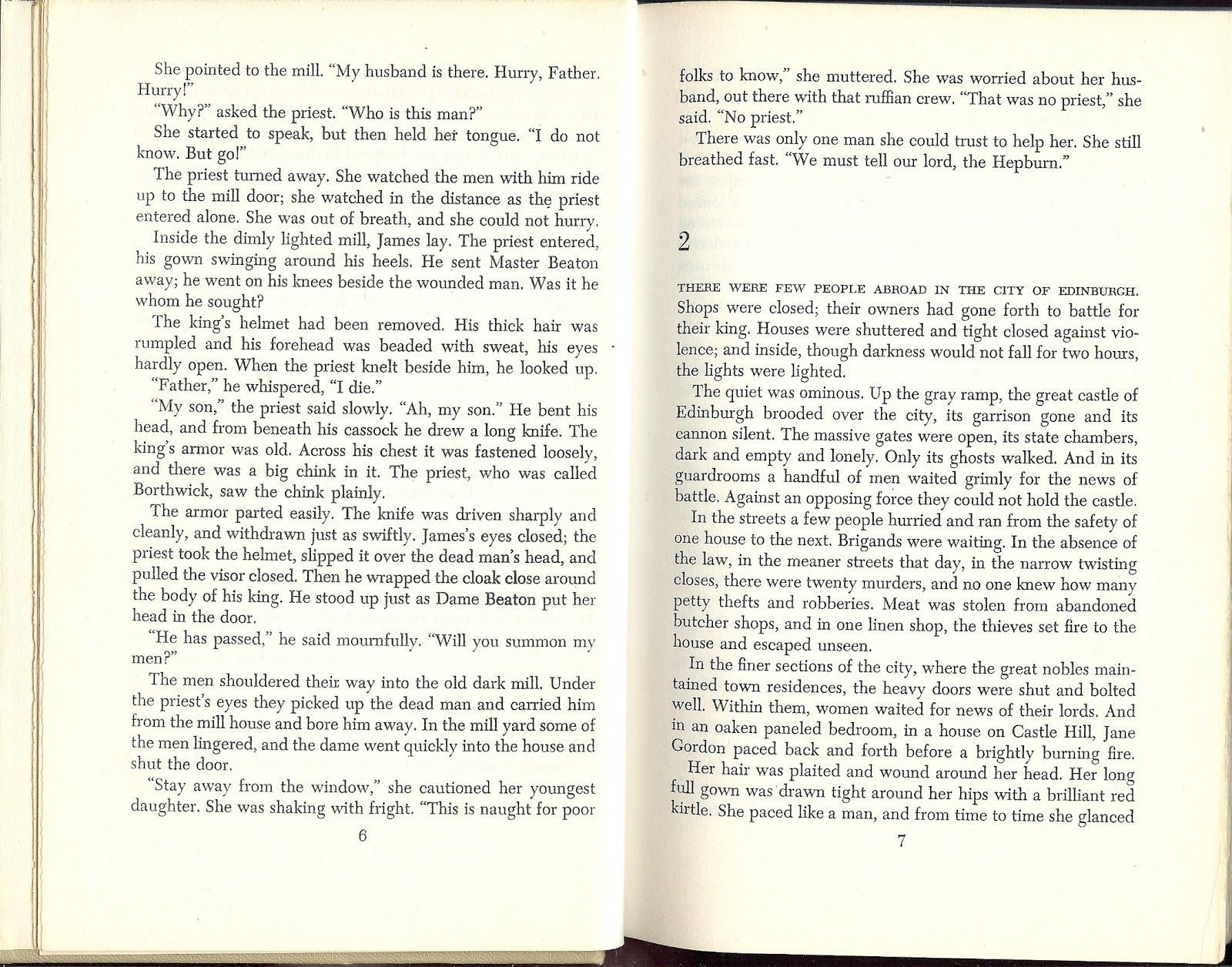


From Fires of Surrender by Sylvie F. Sommerfield, (c) ? 1990, Zebra Books/Kensington Publishing Corp.


Monday, February 27, 2012


Subscribe to:
Posts (Atom)